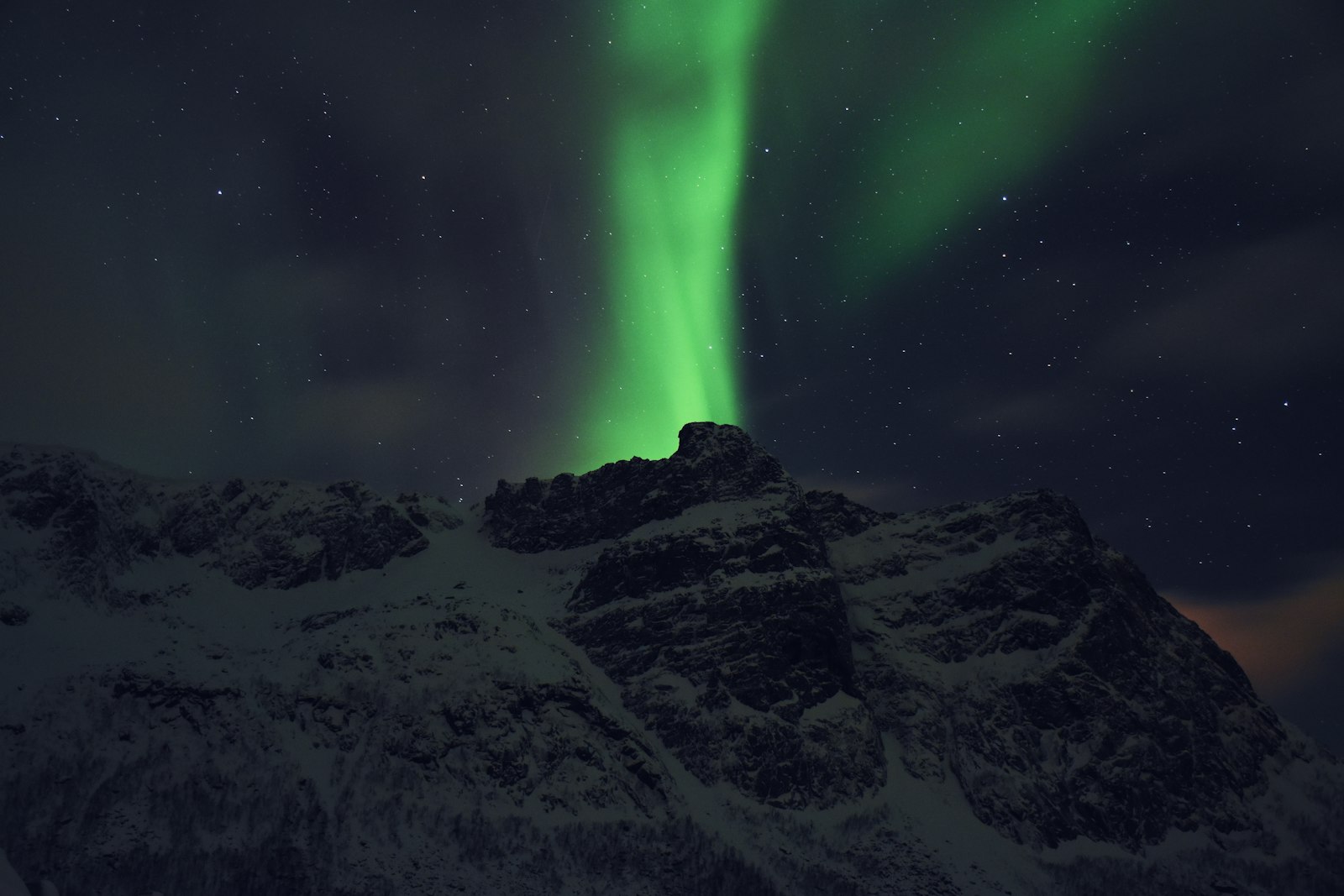
Where to See the Northern Lights: 5 Best Places to Go
🗺 View the 17 places in this post on a map
Seeing the northern lights takes three things at once: a spot under the auroral oval (roughly 65 to 70°N), a properly dark sky, and no clouds. Activity and darkness are things you can plan for. Clouds aren't, so the best aurora destinations are the ones with dry winter weather, or with roads that let you drive out from under a cloud bank. The Sun is just past the peak of Solar Cycle 25, and strong displays will stay more frequent than average through 2026 and 2027, so this winter is a good one to go. Check two forecasts every day: NOAA's 30-minute aurora forecast for activity, and a local cloud-cover map for where to drive. Below are the five places we'd pick, each with the viewing spot locals actually use.
Fairbanks, Alaska. Fairbanks sits almost directly under the oval and has a dry, continental climate, which is why it's the most reliable place in the United States. The season runs from late August to mid-April. The University of Alaska's Geophysical Institute forecast is built for this sky and is worth checking before every night out. You don't need a tour here. Pick up the free aurora viewing map at the Morris Thompson Cultural and Visitors Center, or see the Explore Fairbanks viewing locations, then drive about 20 miles up the Steese Highway to the Cleary Summit pullouts. Locals tend to prefer Murphy Dome, about 25 miles northwest and the highest point near town. The last five miles are gravel, and the rim road has pullouts with an unbroken view north. If you'd rather watch from warm water, Chena Hot Springs Resort, 60 miles out, has an outdoor rock lake that stays open late. Borealis Basecamp rents fiberglass igloos with clear roofs, so you can watch from bed. In winter you can ride the train up from Anchorage; our Alaska Railroad guide covers the route.
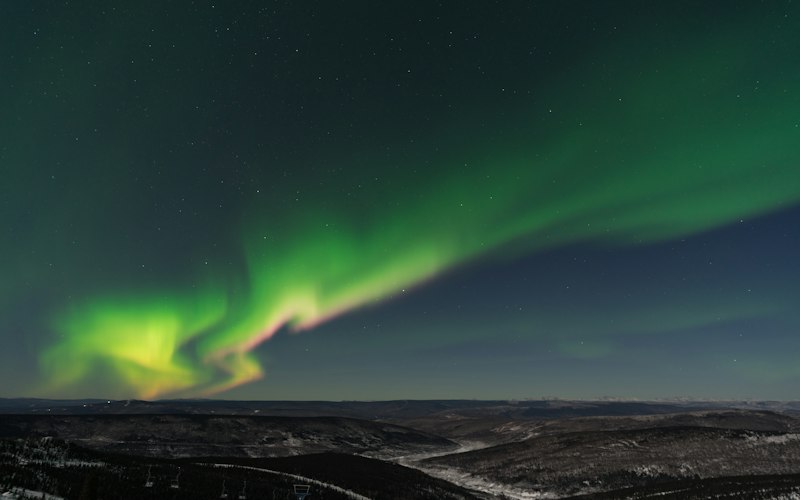
Yellowknife, Northwest Territories. Yellowknife is flat, dry, and right under the oval, with very little light pollution beyond the edge of town. It has a strong claim to the best odds in North America. There are two seasons: mid-August to early October, when the lights reflect off unfrozen lakes, and mid-November to early April, when it's colder but darker. The window in between, while the lakes freeze, is the time to skip. Spectacular NWT lists the licensed operators. The classic option is Aurora Village, where you wait out the night in heated teepees and come out when the sky starts to move. To go on your own, drive the Ingraham Trail east to Prelude Lake Territorial Park, about 45 minutes from town. The boat launch looks out across the lake with almost 270 degrees of open sky. Use real parking areas, though, because winter truck traffic on this road is heavy. Before you head out, eat at Bullocks' Bistro in Old Town, a cluttered log-cabin fish house serving whatever was caught that day: lake trout, whitefish, or pickerel. For a bigger splurge, Blachford Lake Lodge is a fly-in wilderness lodge with no light pollution at all.
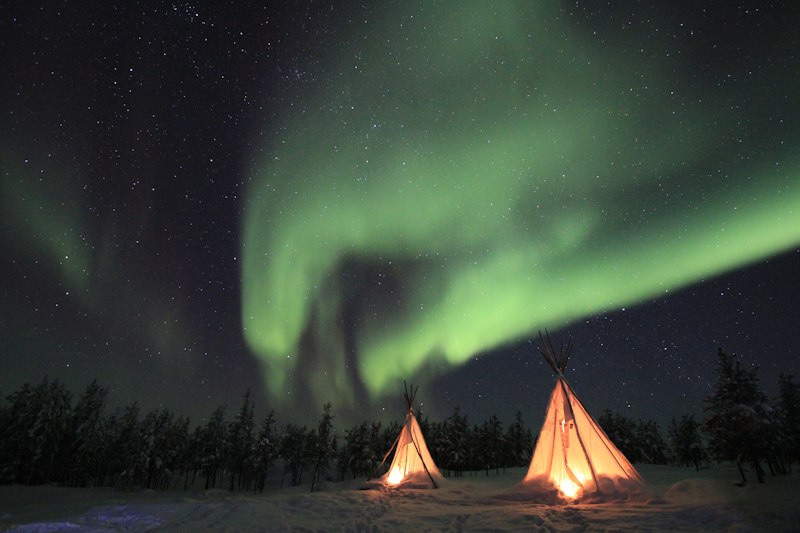
Iceland. Iceland is the easiest place on this list to reach. It's a short overnight flight from the East Coast, and you can add it as a free stopover on an Icelandair ticket (see our Reykjavík stopover itineraries). The catch is the weather. Iceland's Atlantic storms bring a lot of cloud, so treat the Icelandic Met Office aurora forecast and its cloud-cover map as your main planning tool. The season runs from September to mid-April. From Reykjavík, skip the bus tour and walk or take bus 11 to Grótta, the lighthouse at the tip of the Seltjarnarnes peninsula. The view west is over open sea, so it's dark enough for decent displays, and there's a small geothermal foot bath just up the shore to keep you warm while you wait. The lighthouse islet is cut off at high tide, so check tide times before you cross. For darker skies, drive 45 minutes to Þingvellir National Park. Farther south, Hotel Rangá has its own observatory and will wake you when the lights come out. On a longer trip, our Ring Road camper van guide gives you a different dark sky every night.
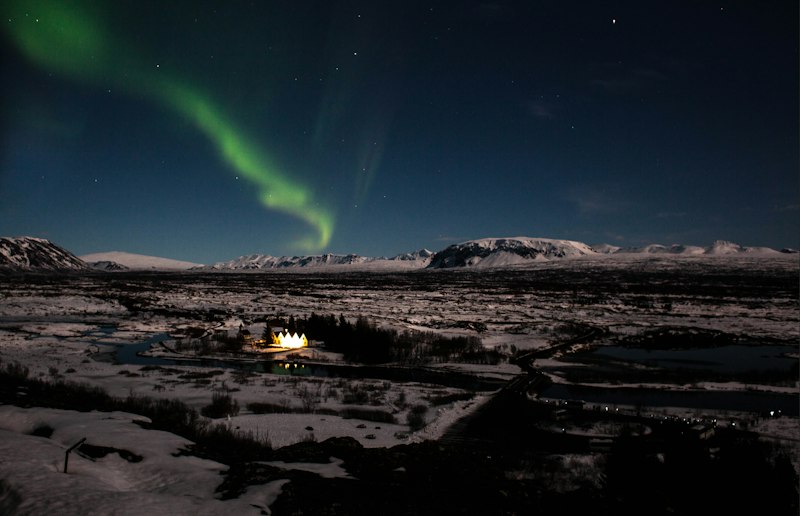
Tromsø, Norway. At 69.6°N, Tromsø is a real city with a cathedral, a brewery, and an airport with direct winter flights from much of Europe, yet it sits right in the aurora zone. The Gulf Stream keeps it milder than you'd expect, but it also brings coastal cloud. That's why the chase tours listed by Visit Tromsø sometimes drive all the way to the Finnish border to find a clear sky. On a clear night you can stay in town. The Fjellheisen cable car runs up to Storsteinen, 421 meters above the city, and you get the aurora over the lights of the fjord. For a darker spot, locals walk or take the bus up to Prestvannet, a small lake at the highest point of the island where the trees block the streetlights. Telegrafbukta, a beach at the southern tip of the island, is the other close-in spot. Polar night runs from late November to mid-January, so even the afternoon can be dark enough. If you'd like to go even farther north, see our Svalbard guide.
Abisko, Swedish Lapland. Abisko's advantage is geography. The mountains around Lake Torneträsk create a rain shadow, and locals call the patch of clear sky that often forms over the village the "blue hole." When the coast at Narvik is socked in, Abisko is often clear. The village sits beside Abisko National Park, and the night train from Stockholm stops right there. Stay at STF Abisko Turiststation, the mountain lodge next to the station. The famous outing is the Aurora Sky Station, a chairlift ride up Mount Nuolja to a viewing hut about 900 meters up. Book it for clear nights and dress for the open lift. On nights you don't go up, walk five minutes from the lodge to the shore of Torneträsk. The frozen lake gives you an open horizon in every direction.
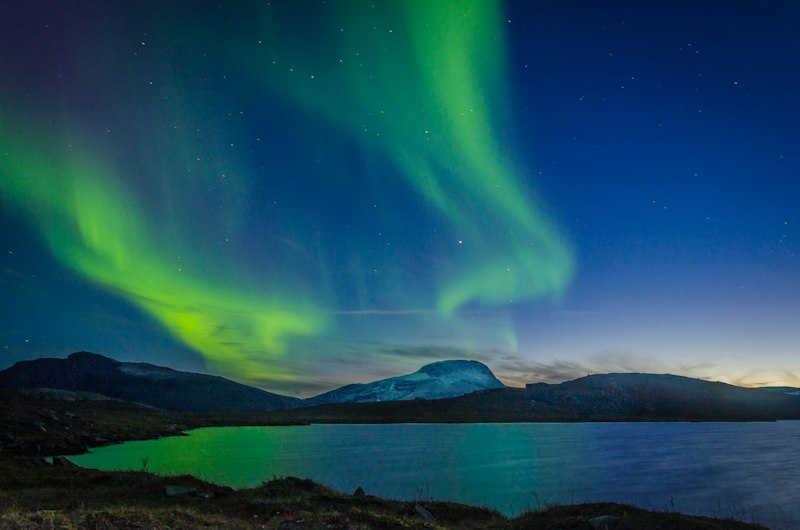
How to plan your trip. Stay at least three or four nights. Displays come in waves, and one cloudy night shouldn't sink the trip. Book around the new moon, since a full moon washes out all but the strongest lights. September, October, and March have the mildest weather and include the equinoxes, when geomagnetic activity tends to rise. December and January give you the longest nights but the deepest cold. Activity usually peaks between about 10 p.m. and 2 a.m., though a storm can light up the sky early in the evening. A phone in night mode is enough, but a camera on a tripod with a wide lens open at f/2.8 and a 5 to 10 second exposure does far better. Dress in layers you'd ski in, add insulated boots and a spare battery kept in an inner pocket, and give your eyes 20 minutes away from screens. Faint auroras look gray to the naked eye and only turn green in the camera, so take a test shot before you decide nothing's happening.

About the author
Kristian Ranstrom
I built Get Busy Exploring because I kept losing track of where I'd been. I chase lists — fourteeners, highpoints, Munros — and I'm just as happy getting lost in a city on foot. I write up the trips here: routes, itineraries, and what I'd do differently.