🗺 View the 12 places in this post on a map
Before Beijing was anything, Xi'an was everything. Thirteen dynasties ruled from this spot on the Wei River plain, and when it was Chang'an — the eastern end of the Silk Road and the largest city on Earth — its markets sold Persian glass and its million residents included monks, merchants, and envoys from half the known world. Modern Xi'an wears that history casually: a completely intact Ming city wall around a downtown of noodle shops, Tang pagodas rising between metro stops, and an army of clay soldiers standing guard in the eastern suburbs. Give it three or four days. Spring (March–May) and autumn (September–October) are the kind seasons; avoid the national holiday crush in early October at all costs. Getting here is easy — it's four and a half hours from Beijing by high-speed rail — and China's recently expanded visa-free entry and transit policies have made the trip far simpler for many nationalities than it was a few years ago; check the current rules for yours before booking.
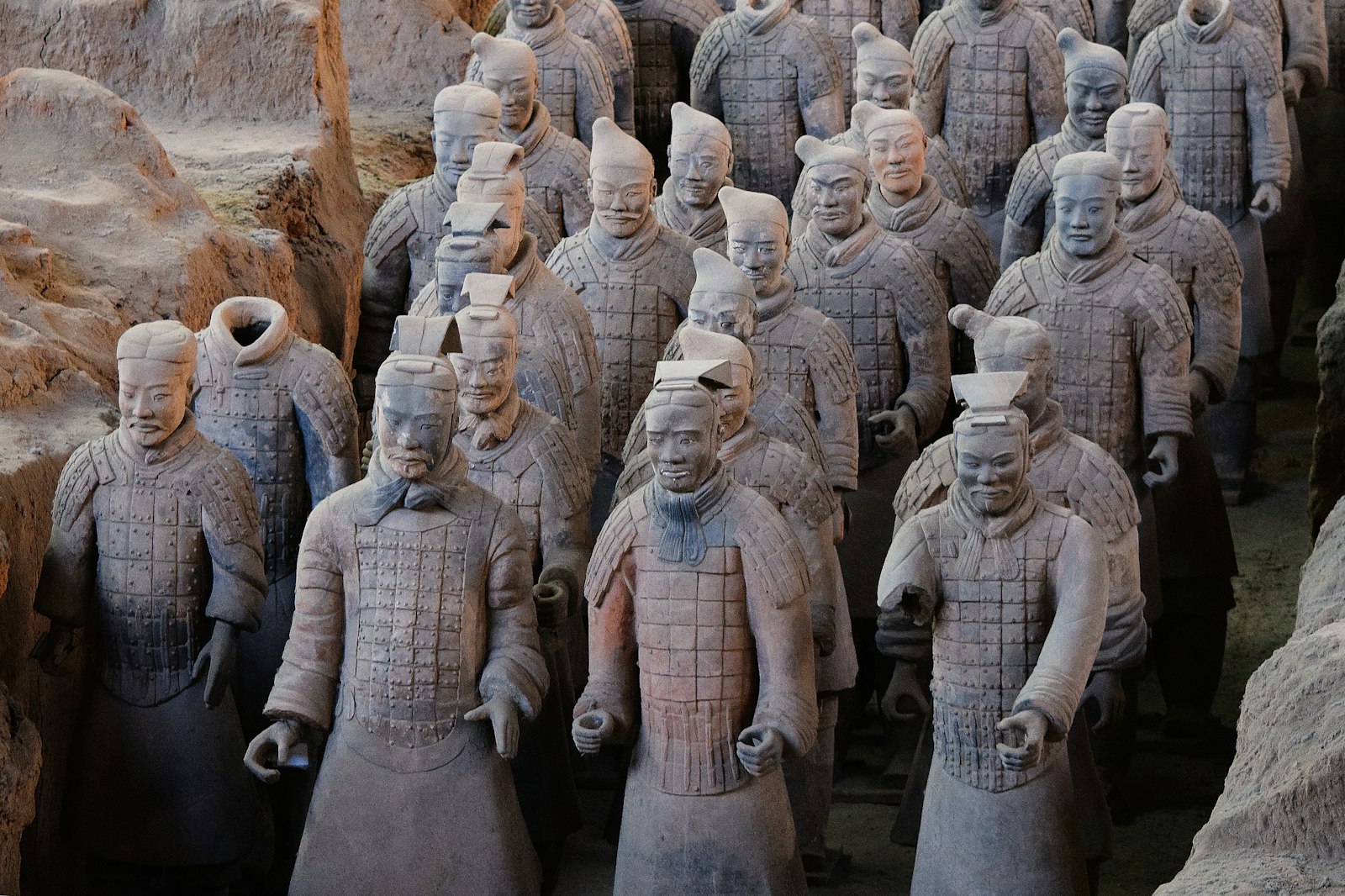
The Terracotta Army earns every superlative. An hour east in Lintong, the Emperor Qinshihuang's Mausoleum Site Museum holds the 8,000-strong clay bodyguard buried with China's first emperor around 210 BC — each soldier with an individual face, discovered in 1974 by farmers digging a well. See the pits in reverse: start with the small Pit 3 command post, then Pit 2's kneeling archer (the collection's masterpiece, displayed in glass), and save the overwhelming Pit 1 — ranks of warriors receding into an aircraft-hangar hush — for last, when you understand what you're looking at. Go at opening or after 3pm to dodge the tour-group tide, book tickets on the official channel a day or two ahead, and budget half a day including the ride out (Metro Line 9 plus a short transfer, or a direct tourist bus from the railway station).
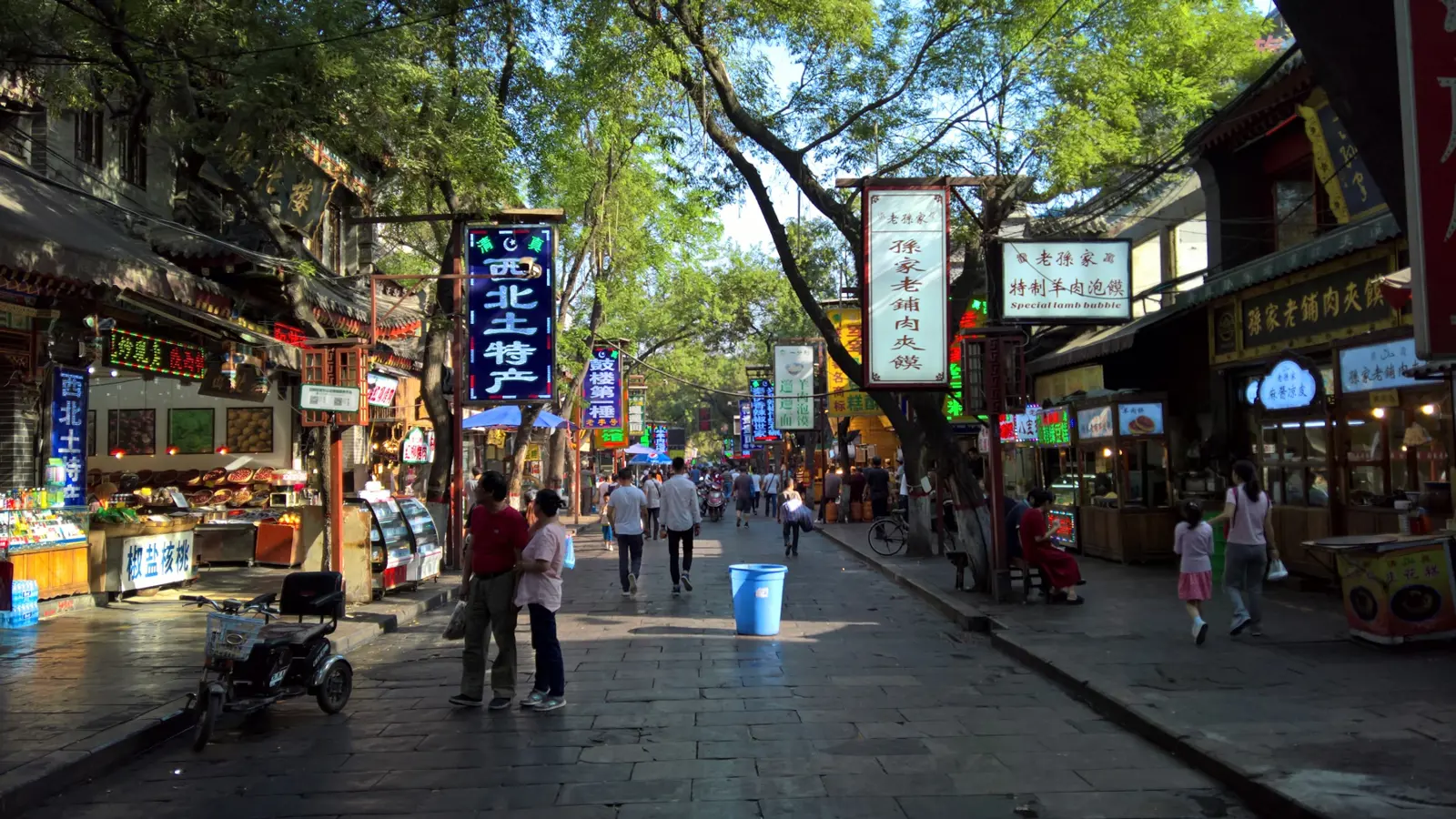
Ride a bike on top of the city wall. Xi'an's Ming-dynasty wall is the best-preserved urban fortification in China — 14 kilometers of rampart, wide as a boulevard, enclosing the whole old city in a neat rectangle. Rent a bike on top at the South Gate (Yongningmen) and do the full loop in about two unhurried hours, rolling past watchtowers with the drum of your tires on old brick and the city moving below. Time it for the last two hours of daylight: you'll finish the loop as the lanterns come on and the gate towers light up. It is, by a comfortable margin, the best €6 of exercise in China.
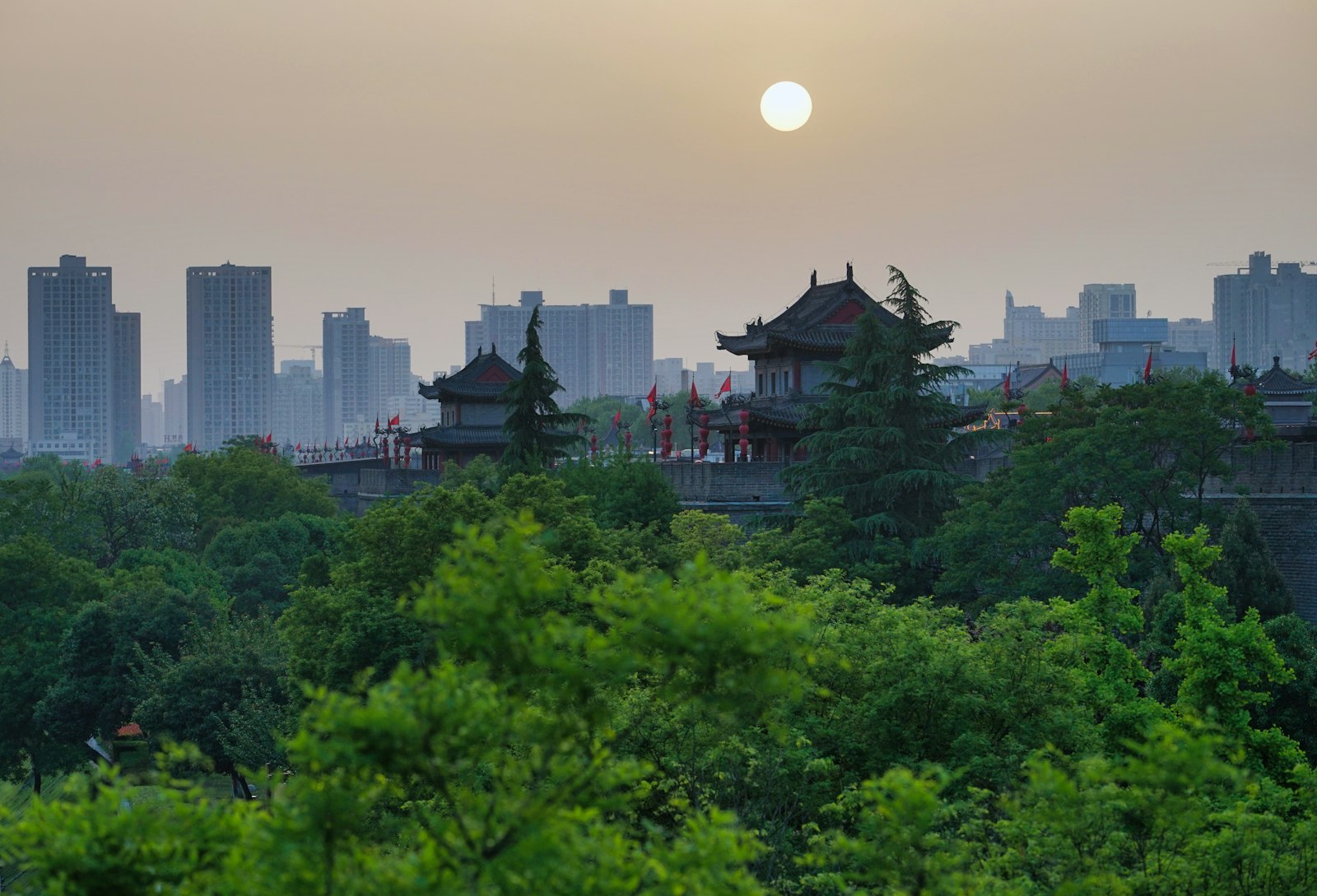
Eat your way through the Muslim Quarter — then go one street deeper. The lantern-lit main drag of Beiyuanmen is the spectacle everyone photographs: cleavers flashing, pomegranates juiced to order, skewers by the thousand. Do it once for the theater, and duck into Huajue Lane for the Great Mosque, a 1,300-year-old mosque built entirely in the form of a Chinese temple garden — one of the most quietly remarkable buildings in the country. Then eat where the Hui families who built this quarter actually eat: Sajinqiao, the neighborhood's western street, a decades-old 24-hour food strip where the stalls have regulars instead of queues of tourists. Beyond the quarter, two institutions demand pilgrimage: Fanji Lazhi Roujiamo on Zhubashi Street, whose century-old braised-pork roujiamo is the sandwich against which all others are measured, and Lao Sun Jia, serving yangrou paomo — mutton soup poured over flatbread you tear into pellets yourself — since 1898. Order biangbiang noodles somewhere, anywhere; the belt-wide, chili-slicked ribbons are named for the sound of dough slapping the counter.
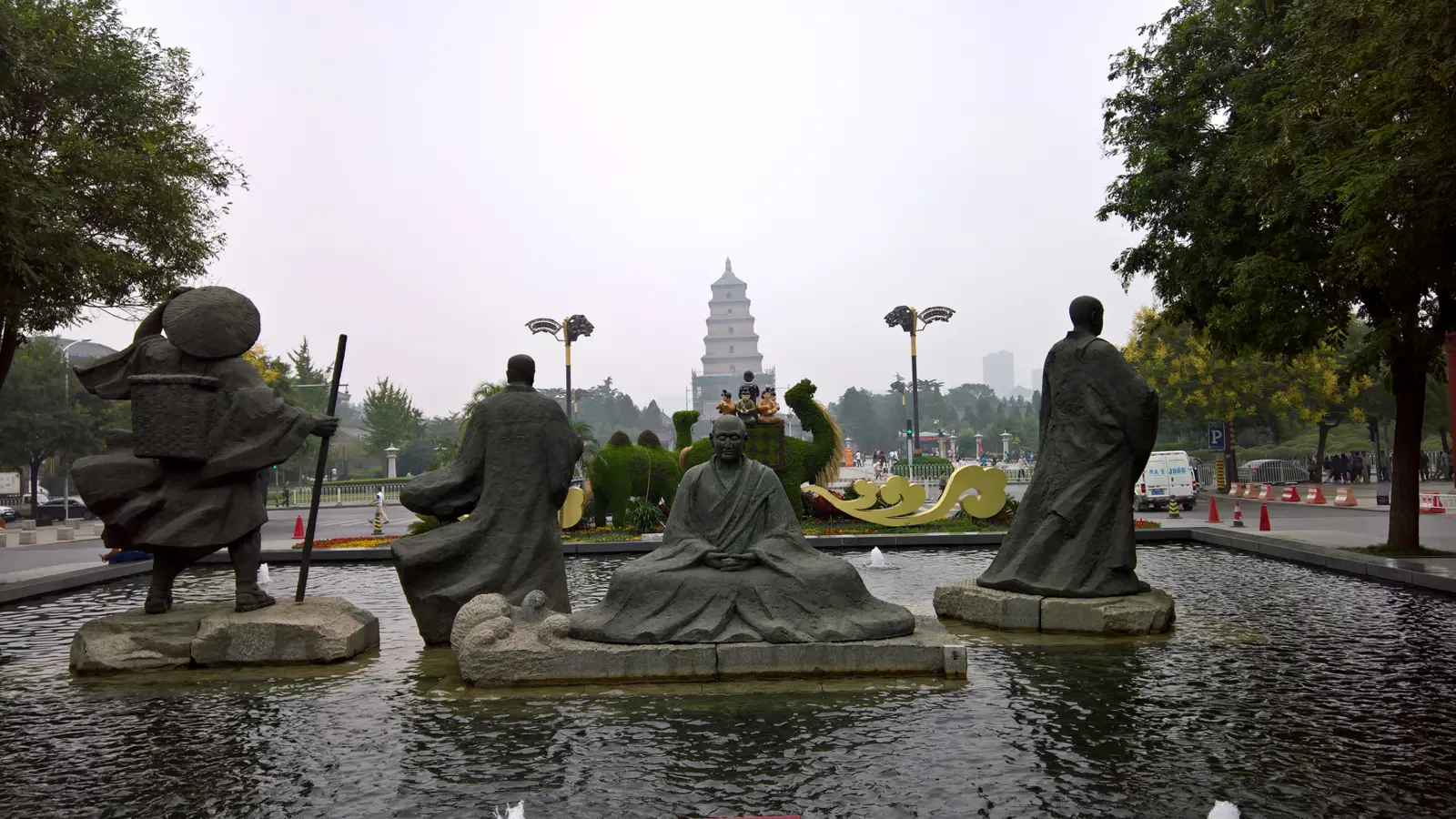
Give an evening to the Tang dynasty. The Giant Wild Goose Pagoda was built in 652 to house the Buddhist sutras the monk Xuanzang hauled back from India — the real journey behind the Monkey King legends — and it still presides over the Da Ci'en Temple grounds with perfect Tang gravity. Come at dusk: the statue-lined squares around it fill with families, the fountain show on the north plaza runs to music after dark, and the adjacent Datang Everbright City pedestrian mall turns into a glowing Tang-themed promenade where half the crowd has rented hanfu robes for their photos. It's theatrical, unabashedly so, and completely winning.
For the quiet version of all this, walk five minutes off the circuit. The Small Wild Goose Pagoda, the Giant's slender 707 AD sibling, sits in a garden of ancient trees where retirees practice calligraphy with water brushes on the flagstones — same dynasty, a fraction of the visitors, and the excellent Xi'an Museum shares the grounds. Pair it with the Shaanxi History Museum, whose Tang gold, Silk Road artifacts, and murals make the best possible prologue to everything you've been seeing; entry is free but timed tickets release days ahead and vanish, so book the moment your dates are fixed.
Practical notes: the metro is cheap, signed in English, and reaches nearly everything; set up Alipay or WeChat Pay with a foreign card before arrival — both now support them, and street stalls are functionally cashless. Summer is hot and hazy, winter cold and hazier; pack accordingly and check the air quality app along with the weather. Base yourself inside the wall near the Bell Tower for atmosphere or in the Yanta district for the pagoda-and-museum cluster. And learn the Xi'an ordering rule: if a restaurant has a queue of locals at noon and laminated menus older than you, the roujiamo is going to be excellent.
About the author
Kristian Ranstrom
I built Get Busy Exploring because I kept losing track of where I'd been. I chase lists — fourteeners, highpoints, Munros — and I'm just as happy getting lost in a city on foot. I write up the trips here: routes, itineraries, and what I'd do differently.